Remarks on the reporting
Latest Update: March 2026
The Extractive Industries Transparency Initiative (EITI) is a global standard that promotes financial transparency and accountability of government revenues generated by the extractive industry. By implementing the voluntary initiative, which is based on the EITI standard, over 50 countries worldwide are helping to combat corruption and mismanagement and promote good governance in this important economic sector.
National implementation and reporting topics
A Multi-Stakeholder Group (MSG) was established at the beginning of 2015 to implement the EITI standard in Germany (D-EITI). The group, which includes representatives from government, private sector and civil society, is responsible for the implementation and regular EITI reporting in accordance with the EITI standard. Since 2023, the mandatory information and data have been published online on the D-EITI website’s reporting portal during the course of the reporting year.1 Additional reports are also published on topics that the D-EITI MSG believes are relevant for the extractive sector.
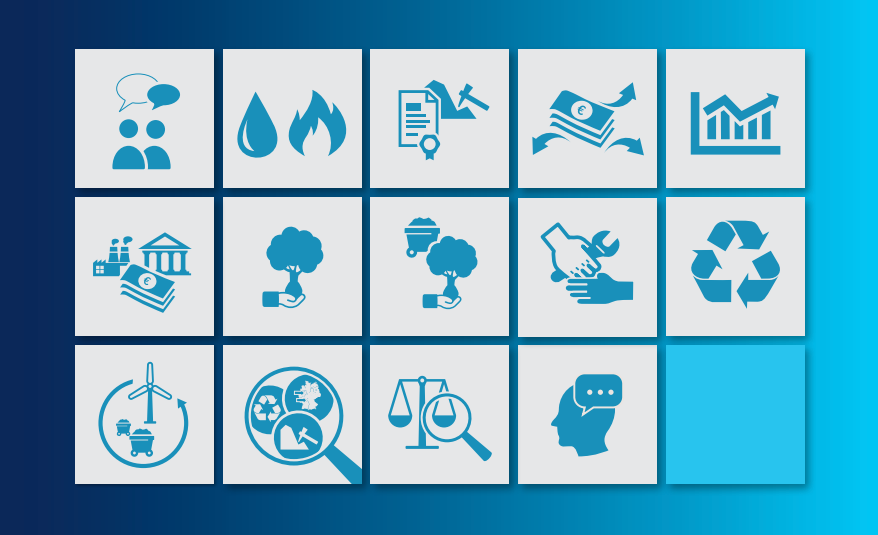
D-EITI reporting thus offers the public the opportunity to find out about various different, yet interconnected topics relating to natural resource extraction in Germany. These are:
- The extractive industry in Germany
- Natural resource production in Germany
- The legal framework for the extractive industry
- The economic importance of the extractive industry
- Sustainability in the extraction of natural resources
- The energy transition and security of supply
- Payment flows of the extractive industry (report by an independent administrator)
Summary
With the eighth D-EITI report (reporting year 2023/2024), the D-EITI Multi-Stakeholder Group would like to focus on the following information relating to the extractive sector and the environment in which it applies:
The most important revenues from the extraction of natural resources on the state side are the taxes gained from general company taxation (corporate tax and income tax, together with solidarity surcharge and trade tax). These are supplemented by the natural-resource-specific mining site and extraction royalties. Together, these revenues generated by the extractive industry amounted to approximately EUR 578 million in 2023. This represents 0.03% of total Federal Government revenue. Compared to the previous year (around EUR 814 million), revenues have fallen by around 37% (cf. Contribution to government revenue).
Disclosure of the payment flows from the extractive industries has shown the following: In 2023, the payments made to government agencies by the companies participating in the D-EITI process for the payment flows of corporation tax, trade tax, mining site and extraction royalties, lease payments, and payments for infrastructure improvement amounted to EUR 650 million. Compared to the previous year (EUR 803 million), revenues increased by 19% (cf. Disclosed payment flows).2
In 2023, 59 new mining licenses were granted nationwide in the sectors monitored by the D-EITI. According to the Federal Office of Statistics, on the last key date of 31 December 2023, approx. 1,285 km², i.e. approx. 0.36% of the area of the Federal Republic of Germany, was being used as mining land (mining operations, opencast mining, pits, quarries). Compared to the previous year, the use of land as mining land has thus fallen minimally (cf. Managing human intervention into natural environments and landscapes).
The report provides an overview of the contribution of the domestic extractive sector and of the relevant energy sources in Germany. In 2023 (2024), the share of primary energy consumption in Germany accounted for by the natural resources included in the D-EITI report was around 36.4% (36.5%) for crude oil, 24.6% (25.9%) for natural gas, and around 8.4% (7.6%) for lignite. Domestic production of crude oil and natural gas covered around 2% and around 6% of consumption in Germany respectively, while lignite production covered around 100%. The share of hard coal in primary energy consumption was lower than in the previous year, amounting to around 8.1% (cf. The extractive industry in Germany). In 2024, renewable energies covered 22.4% of final energy consumption and 54.4% of gross electricity consumption in Germany. The most important renewable energy source in the electricity sector is wind energy, which accounts for 27% (2024) of German electricity consumption (cf. Effects of the energy transition and structural change on the extraction of natural resources in Germany).
In addition to the extraction of primary raw materials, the demand for natural resources is partly covered by recycling. The recycling industry therefore plays an important role as a source of natural resources. The D-EITI report presents the legal basis and examples of recycling rates, as well as utilisation rates and future challenges for the circular economy in Germany (cf. Circular economy, in particular recycling).
Part of Germany’s exports come from the domestic extractive sector. In 2023 (2024), Germany exported goods worth a total of around EUR 1.58 trillion (EUR 1.57 trillion). Products of the extractive industries accounted for some EUR 5.2 billion of this amount (EUR 4.7 billion), according to the primary raw materials considered by D-EITI – equivalent to 0.33% (0.30%) of total exports. At around EUR 2.9 billion (EUR 2.5 billion), crude oil and natural gas accounted for the largest share of exports. However, these are predominantly re-exports of natural gas (cf. Economic importance of the extractive industry).
As a major player in industry and technology, Germany is dependent on a secure supply of energy and non-energy (mineral) natural resources. For important future technologies – for renewable energies (RES), and for digitalisation and electromobility in particular – even more mineral natural resources will be needed in the future. The report discusses the three pillars that are relevant for natural resource requirements in Germany with regard to the security of supply: domestic primary natural resources, secondary natural resources, and natural resource imports (cf. Contribution of the domestic extraction of natural resources to supply security considering Germany’s role in the international natural resource market).
Every mining operation requires interventions into natural environments, some of which can be serious (cf. Managing human intervention into natural environments and landscapes). The report explains the environmental provisions and approval practices for mining interventions, as well as the responsibilities of the authorities. In addition to this, the topic contains information on access to compensatory measures and payments, provisions and implementation securities from extractive companies for the restoration/rehabilitation of former mining areas and water abstraction fees (cf. Contribution to water).
The report also gives an overview of Employment and Social Affairs. At the end of 2023 (2024), around 58,000 people (56,000 people) were employed in the extractive industry. This corresponds to around 0.17% (0.16%) of all employees in Germany who are subject to social security contributions. Compared to the reporting period 2016 (1st D-EITI report), the number of employees in the sector fell by around 13,300 in 2023 (approx. 14,800 in 2024), mainly due to the phasing-out of hard coal mining by the end of 2018. At the same time, employment is increasing in the Renewable Energies sector, which provided employment for more than 406,000 people in 2023. The report also discusses the legal regulations on social protection, corporate responsibility and due diligence obligations, as well as diversity and equal opportunities for employees in the field of German natural resource extraction (cf. Employment and Social Affairs).
Risk-based approach for quality assurance of payment data
The MSG uses a procedure for risk-based quality assurance of payment flows in the area of financial transparency, in which the payments made by extractive companies to government agencies are disclosed.
Since the third reporting cycle, the reconciliation of payments made by extractive companies participating in the D-EITI with the revenues of government agencies, known as payment reconciliation, has been replaced by a general and risk-based analysis of government processes. This is used as the basis for quality assurance. The risk-based quality assurance of payment data was included by the international EITI Management Board as a standard procedure in the EITI specifications for implementation in all EITI member countries in October 2024. The D-EITI is thus successfully contributing to the further development of the international EITI standard.
Quality assurance of the payment data
The collection of payments, the quality assurance process and the risk assessments were carried out and supported by an independent administrator appointed by the MSG in accordance with the EITI Standard. Participation for the reporting companies was voluntary. For the eighth reporting cycle, the Independent Administrator determined that there is a low risk that the payment flows are not in order. As such, a plausibility check of the payment data is sufficient. This ensures the quality of payment data sent to government agencies.
This eighth D-EITI report was prepared by the German MSG in cooperation with the Independent Administrator at Deloitte GmbH, auditing company.
Under the heading Payment flows of the extractive industry , you will find the information for the reporting year 2023. The remaining tiles contain additional data for 2024, where available.
More information: How the EITI works, Participants in the MSG
MSG objectives for D-EITI
We, the Multi-Stakeholder Group (MSG), are committed to the principles set out in the EITI Standard 2023 and have therefore set ourselves the following objectives for the implementation of the EITI in Germany:
- ensuring timely reporting that is understandable and accessible to the general public, based on a transparent, open and innovative EITI process in Germany;
- preparing contextual information on the German extractive sector to promote a broad discussion on raw materials policy, which also includes aspects of sustainability (economy, environment and social affairs);
- delivering a gradually expanding, comprehensible and proportionate reporting to the public that meets the EITI Standard and harmonises with the EU Accounting Directive and the EU Transparency Directive. At the same time, added value is to be created;
- contributing to the further development of the EITI Standard, its application and acceptance as a truly global standard to support the global quest for transparency and accountability and the fight against corruption in the raw materials business;
- sharing experiences from the multi-stakeholder process, particularly with regard to democratic participation, proximity to citizens and knowledge networking, as well as from EITI implementation in a federal country;
- significantly increasing Germany’s credibility in providing political and financial support to the EITI;
Sources
1 Previous D-EITI reports can be accessed via the Documents section of the D-EITI website.
2 Note: The disclosure of government revenue is based on the statistical codes (NACE) of the core economic activities. Mixed companies with minor extractive activities may not be included in these government statistics, though they do report to the D-EITI and report their payments accordingly to the Independent Administrator. At the same time, government statistics may include companies falling below the D-EITI’s materiality threshold (EUR 100,000 per payment flow per company/year). As a result, the sum of payments reported by companies to the Independent Administrator (disclosure of payment flows from extractive industries) may differ from the above government reporting on extractive revenues. Furthermore, the reported values are also influenced by differences in presentation methodology. The disclosed government revenue presents a netted amount that includes both government revenue and repayments to companies. On the other hand, company enquiries within the framework of the D-EITI and in the published payment reports are predominantly presented from a cash outflow perspective. Only payments made by companies to the government are presented; repayments are not taken into account. This procedure corresponds to the approach outlined in IDW Practice Statement 1/2017. Due to the sharp fluctuations in gas prices as a result of the Russia-Ukraine conflict, millions of euros in extraction royalties were paid back to companies in the 2023 calendar year, as the advance payments made in 2022 were too high. These repayments were largely not taken into account in the D-EITI data report. This difference in the modes of presentation has led to a deviation in the two-digit million range. This fact was identified, analysed, and verified by the Independent Administrator as part of the quality assurance process, and explained accordingly in the IA report.