Which natural resources are extracted in Germany?
Crude Oil and Gas
Latest Update: November 2025
EITI Standard:
Crude Oil
History
Crude oil has been industrially extracted in Germany for more than 150 years. The successful oil well in Wietze near Celle in 1858/59 is generally recognised as being one of the first in the world. Crude oil production in Germany peaked in 1968 with an annual production of around 8 million tonnes. Most of the crude oil reserves are in the North German Basin, primarily in Schleswig-Holstein and Lower Saxony.
Economic importance
With a share of around 36 % of primary energy consumption, crude oil is by far the most important energy source in Germany. In this context, fossil fuels with a share of about 78 % (2023) and 77 % (2024) generally account for a much larger share than renewable forms of energy (see also see also Effects of the Energy Transition and the Structural Change).1 In 2023, domestic oil production amounted to around 2 % of Germany’s annual consumption and the share thus remained the same compared to the previous year. Germany is one of the world’s largest users of mineral oil, making it almost entirely dependent on importing crude oil and crude oil products. Crude oil imports fell to around 77 million tonnes in 2023. These imports in total were valued at about EUR €45 billion and came from 32 countries, with 59 % of the imported crude oil coming from the USA (14.2 million tonnes), Norway (13.8 million tonnes), Libya (8.8 million tonnes) and Kazakhstan (8.7 million tonnes) – all figures for 2023.2 Until mid-2023, Russian crude oil was imported exclusively in the form of linefill (residual quantities in the Druzhba pipeline, about 0.2 million tonnes) and has since no longer played a role in the area of crude oil imports.3 Proven and potential crude oil reserves in Germany were estimated to be almost 23 million tonnes as of 1 January 2024. Germany produced about 1.6 million tonnes of crude oil in 2023.4 The country’s share of global oil production amounted to approx. 0.03 % in 2023. The value of crude oil produced in Germany in 2023 is estimated to be EUR 781 million, which represents 0.02 % of GDP. Crude oil accounted for around 5 % of the total value of natural resources produced in Germany in 2023.
In terms of economic significance, crude oil thus ranked third behind lignite and natural gas in the list of fossil energy resources produced in Germany and in seventh place out of all natural resources extracted nationwide. In a 2023 international comparison of crude oil-producing countries, Germany was in 57th place (1970: 26th place). At the end of 2023 (2024), 1,940 (1,644) persons were employed in oil production in Germany (see also Employment and Social Affairs).
Extraction
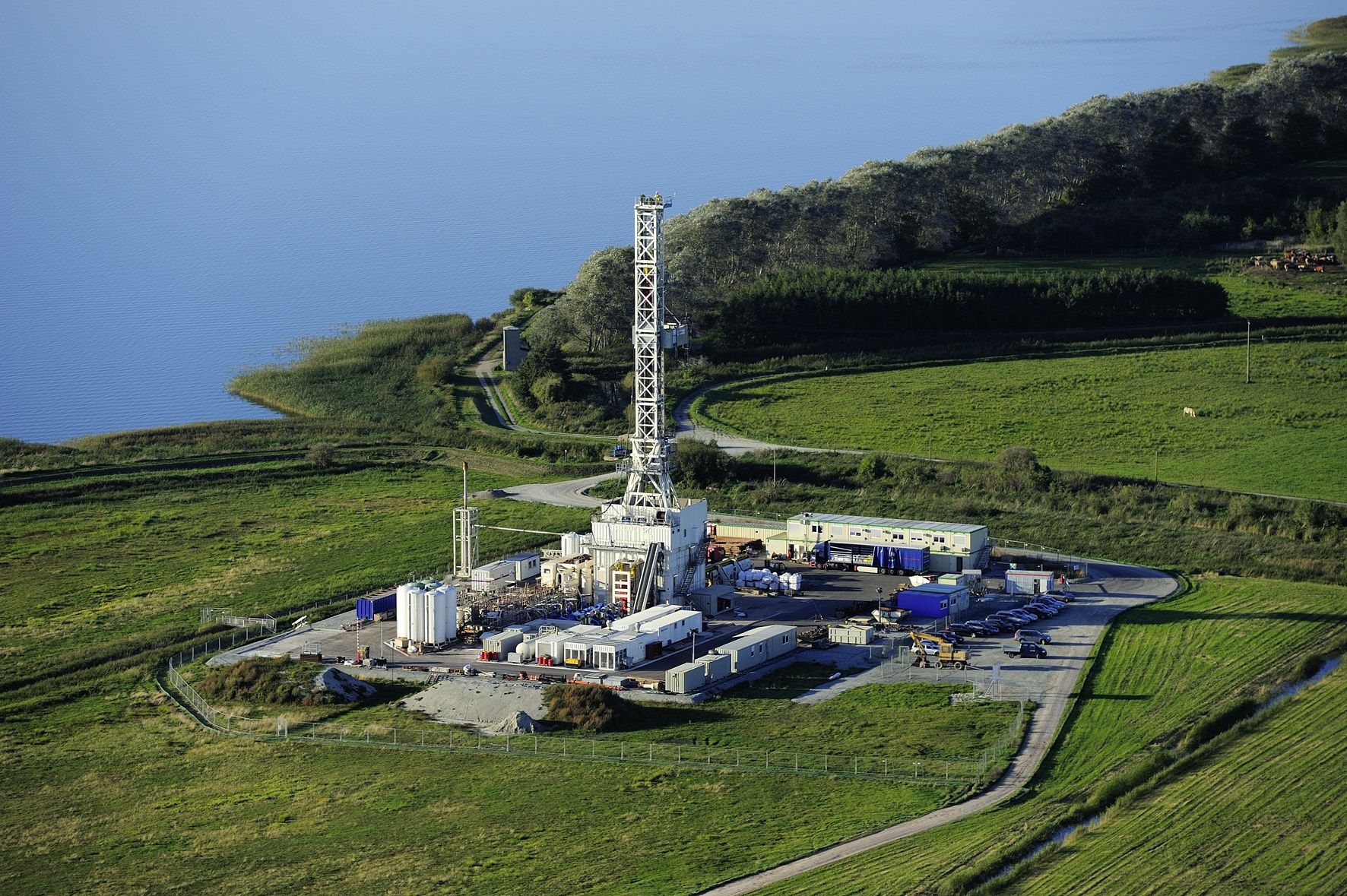
In 2023, 45 oil fields were in production in Germany. These fields extract oil by means of some 685 production wells in drilling installations (onshore) and production platforms (offshore). In 2023, the oil fields of Schleswig-Holstein and Lower Saxony yielded almost 90 % of the total German production. The remaining quantity was mainly produced in the Federal States of Rhineland-Palatinate and Bavaria, together with very low production levels in Hamburg, and Mecklenburg-Western Pomerania. The largest German crude oil field is the Heide-Mittelplate I field in the Schleswig-Holstein Wadden Sea (Wattenmeer) National Park. It has been developed since 1987 by a drilling and production platform and by oil well facilities on the mainland. This oil field accounted for about half of Germany’s total crude oil production in 2023. Information on exploration and production in the crude oil and natural gas sector is included annually in the report “Crude oil and natural gas in the FederalRepublic of Germany” of the State Office for Mining, Energy and Geology.
Uses
Crude oil is a fossil fuel and mainly used as fuel for vehicles and means of transport and for heating buildings. Over the last few years, oil has accounted for 93 % of energy consumption in the transport sector and has been used in the form of gasoline, diesel and aviation fuel.5 In 2023, 28.5 % of residential buildings in Germany were still heated with fuel oil, especially in rural areas without a connection to the gas grid. Crude oil is also used in the chemical industry in particular, for example in the production of plastics and dyes, foams, detergents, medicines, lubricants and cosmetics.
Natural gas
History
The oil crises of the 1970s focused increased attention on the consumption of energy and the need for the development of energy sources.
Domestic production grew with the discovery of large gas deposits on the German-Dutch border and the increasing conversion of town and coke-oven gas to natural gas (from 12 to about 20 billion m³ (Vn)6 raw gas between 1970 and 2005). This was accompanied by a steady expansion of the gas infrastructure.
Economic importance
Natural gas is still the second most important source of energy in Germany with a share of around 25 % of primary energy consumption. In 2023, natural gas production in Germany amounted to around 4.6 billion m³ (Vn) of raw gas, covering only about 6 % of domestic natural gas consumption. In 2023, this share fell by around 2.5 % compared with the previous year. In 2023, 968 TWh of natural gas valued at around EUR 44 billion were imported. The most important importing countries in 2023 were Norway (421 TWh), the Netherlands (250 TWh) and Belgium (212 TWh). From September 2022, the direct supply of Russian pipeline gas to Germany was stopped completely. Apart from that, there was a reduction in imports (-33 %) compared to the previous year. One proportion of the natural gas imported was re-exported to neighbouring European countries (187 TWh). At the end of 2022, LNG (liquefied natural gas) was imported directly to Germany for the first time using the floating LNG terminal in Wilhelmshaven.7 In 2024, the volume of LNG imported via all LNG terminals (Wilhelmshaven, Brunsbüttel, Lubmin and Mukran) amounted to 68 TWh. In 2024, 92 percent of these terminals were supplied with LNG from the USA. The total share of LNG from the USA in German gas imports was thus about 17 %. Other countries of origin of LNG imports were (with decreasing importance) Norway and Angola.8 In 2024, direct LNG imports into Germany accounted for around 8 percent of total gas imports. In terms of the economic significance of domestically produced natural gas, Germany ranked number 50 in the comparison of all natural-gas-producing countries in 2023.9 The country’s share of global natural gas production amounted to about 0.1% in 2023. The value of the natural gas extracted in 2023 amounted to an estimated EUR 2 billion. That is equivalent to about 0.1 % of GDP. Natural gas accounted for around 15% of the total value of natural resources produced in Germany in 2023. At the end of 2023 (2024), 1,065 (1,071) persons were employed in the German production of natural gas (see also Employment and Social Affairs).10
Extraction
In 2005, domestic natural gas production covered around 25 % of German natural gas consumption. Since then, however, production has declined. The sure and probable reserves of natural gas are also declining. These amounted to around 36 billion m³ (Vn) as of 1 January 2024. The decline in natural gas reserves and production is mainly due to the increasing depletion of the deposits and the resulting natural decline in extraction. There have not been any significant new discoveries in recent years either due to declining exploration activities against the background of social and political conditions.
Almost 98 % of German natural gas was extracted in Lower Saxony in 2023. Other Federal States (Saxony-Anhalt, Thuringia and Bavaria) contributed only marginally to the total production. Natural gas was extracted from 267 production wells on 64 gas fields. Like crude oil, natural gas can be found in underground deposits. Similar to the exploration of crude oil, the exploration of natural gas takes place primarily through seismic surveys and exploration drilling.11 Natural gas is extracted through a riser pipe inserted into a borehole that is stabilised with cement and steel.
In addition to the development of conventional deposits, non-conventional natural gas deposits could be developed, too. Non-conventional deposits include natural gas deposits in shale, clay, marl and coal seam rock, that can be developed using “hydraulic fracturing” or “fracking” for short. Fracking involves injecting a suspension (water, proppants and additives) and the resulting increase in pressure to create small cracks in the rock containing the natural gas in a controlled manner. This process releases the gas so that it can be brought to the surface through the drilling pipes.
Fracking in Germany has been used for many decades in the development of conventional deposits, especially in dense sandstones (mostly at greater depths) and has been tried and tested for many years. The authorisation is the responsibility of the federal states and is only granted if environmental risks can be excluded. However, the use of fracking for the commercial development of shale, clay, marl and coal seam rock (i.e. non-conventional deposits), on the other hand, is generally not permitted in Germany until further notice due to environmental concerns and the threat to groundwater. This excludes up to four test drillings. However, there must be scientific monitoring.12,13 The German Bundestag has not yet made use of the opportunity to review the ban on fracking on the basis of the report submitted by the Expert Commission on fracking in 2021.14 The topic of fracking continues to be discussed controversially in Germany.
Uses
As a fossil fuel, natural gas is mainly used in industry (34 %) and in private households (32 %, mainly for heating). In addition, it is used to generate electricity (13 %) in the trade, commerce and services sectors (14 %) and in district heating/cooling (including combined heat and power plants; 7 %). In transport, natural gas plays a very minor role as a fuel. Natural gas also other uses – as a reactant in chemical processes (e.g. for ammonia synthesis in the Haber-Bosch process (nitrogen fertiliser)), for iron ore reduction in the blast furnace process but particularly in the production of hydrogen through steam reforming.
Sources
1 AG Energiebilanzen e.V. [Working Group on Energy balances] (AGEB) (2024): Energy consumption in Germany in 2023
2 A list of the most important oil-producing countries can be viewed here: Eurostat – European Commission (2024): Imports of oil and petroleum products by partner country – monthly data.
3Federal Statistical Office (2023): Crude oil imports from Russia decreased to 3,500 tonnes in January 2023.
4 Information on significant exploration projects can be found, for example, here: LBEG (2024): Crude oil and natural gas in the Federal Republic of Germany 2023; BVEG (2025): Crude oil production in Germany; BGR (2024): Report on the natural resources situation in Germany 2023
5AG Energiebilanzen e.V. [Working Group on Energy balances] (2024): Evaluation tables for Germany’s energy balance
6 Standard volume (Vn).
7 AG Energiebilanzen e.V. [Working Group on Energy balances] (2024): Energy consumption in Germany in 2023; Destatis (2023): Press release – Crude oil imports from Russia decreased to 3,500 tonnes in January 2023
8 Federal Network Agency – Federal Cartel Office (2024): Monitoring report 2024. Federal Network Agency for Electricity, Gas, Telecommunications, Post and Railways
9 BGR – Bundesanstalt für Geowissenschaften und Rohstoffe [Federal Institute for Geosciences and Natural Resources] (2024): BGR Energy Data 2024 – Data on developments in German and global energy supply
10 More information on gas supply in the year 2023 and 2024
11 Information on exploration and production: LBEG (2024): Crude oil and natural gas in the Federal Republic of Germany 2023; BVEG (2025): Crude oil production in Germany; BGR (2024): Report on the natural resources situation in Germany 2023;
12 Federal Ministry for Economic Affairs and Energy (BMWE): Fracking
13 See Section 13a (2) and (6) of the Water Resources Act
14 Expert commission on fracking pursuant to Section 13a (6) Water Resources Act